

The Pour Over #02 – Light, Medium, Dark – What Do Coffee Roasts Actually Mean?
Most people think coffee comes in three roast types: light, medium, and dark.
But coffee isn’t roasted into categories – it’s roasted along a timeline.
Every coffee bean begins the same way: green, dense, and full of potential. As heat is applied, the bean slowly transforms; losing moisture, changing color, and developing the flavors we recognize in the cup.
What we call “light,” “medium,” or “dark” isn’t a type.
It’s a moment.
The Roasting Process, Simplified
As coffee roasts, it moves through a series of stages:
Drying – moisture evaporates from the bean.
Yellowing – early browning begins, aromas shift.
First Crack – pressure builds and the bean opens with an audible pop.
Development – natural sugars caramelize, and flavors deepen.
Second Crack – the structure breaks down further and oils rise to the surface.
Roasters carefully guide coffee through this process using time, temperature, and airflow. But the most important decision isn’t how the roast begins–it’s when it ends.
Because that single decision determines how the coffee will taste.
Light Roast
A light roast is stopped shortly after first crack, the moment coffee begins to taste like coffee.
At this stage, the bean still reflects much of where it came from. Acidity is more pronounced, flavors are often brighter and more complex, and the origin of the coffee is easier to taste. You might notice notes like citrus, florals, or tea-like qualities.
Light roasts aren't about intensity, they’re about clarity.
Medium Roast
A medium roast continues further into the development phase.
Here, the coffee begins to balance itself. Acidity softens, natural sugars caramelize, and the flavors become smoother and more rounded. This is where many people find the most familiar expression of coffee: approachable, slightly sweet, and easy to return to. You might notice notes like caramel, chocolate or gentle fruit.
Medium roasts are about balance.
Dark Roast
A dark roast pushes further, often into or beyond second crack.
At this point, the structure of the bean begins to break down. Acidity decreases, body increases, and the flavors shift toward deeper, more intense notes created by the roasting process itself. You might notice smokey, roasted or bittersweet flavors.
Dark roasts are about depth.
Roast Level Isn’t Strength
One of the most common misconceptions about coffee is that dark roasts are “stronger.” In reality, roast level has very little to do with caffeine content. A dark roast isn’t stronger; it’s simply roasted longer.
“Strength” is influenced far more by how coffee is brewed than by how dark it is roasted.
Why This Matters
Two coffees being labeled “medium roast” can taste completely different.
That’s because roast level isn’t just about time, it’s about how the roast is managed. Heat, application, airflow, and the natural characteristics of the bean all shape the final result.
Roasting isn’t about fitting coffee into a category, it’s about finding the exact moment where a coffee expresses itself best.
The Cloud & Halo Approach
At Cloud & Halo, we think of roast levels as moments in a larger story. Right now, that story begins with two expressions of balance:
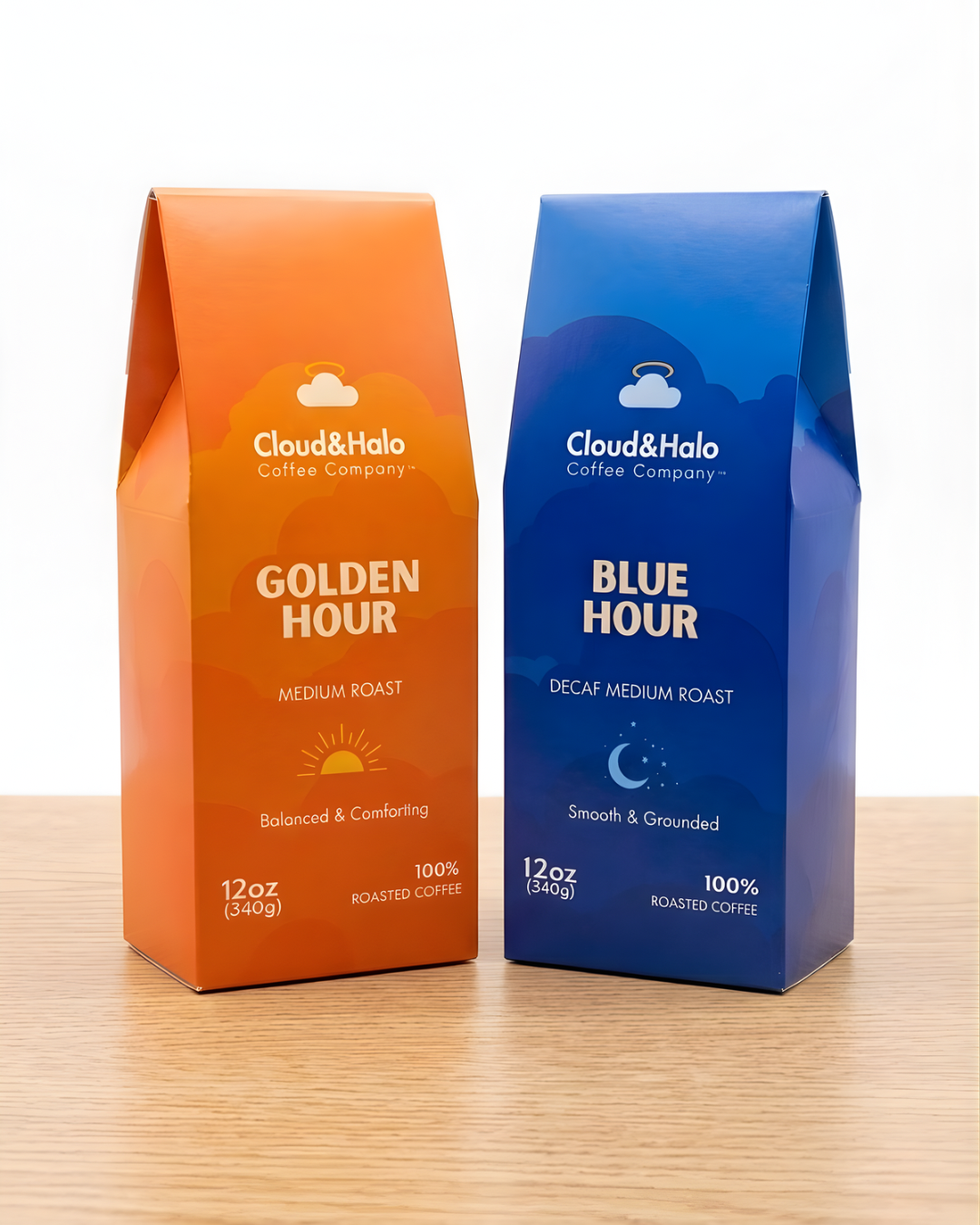
Golden Hour– our medium roast.
Balanced, smooth, and warm, with notes of toffee, dark chocolate, and citrus.
Blue Hour – our decaf medium roast.
Calm, grounded, and approachable, designed for slower moments without the caffeine. While both roasts sit within a pretty similar range, they serve different purposes: one energizing the other unwinding.
Because coffee isn’t just about flavor. It’s about when–and how–you experience it.
As Cloud & Halo grows, so will the range of moments we explore. But every release will follow the same principle:
Not roasting for a category; but roasting to a point of expression.
☁️
Source: Hoffmann, James. The World Atlas Of Coffee. Firefly Books, 2014.
